
The Reserve Bank of India (RBI) has increased its GDP growth forecast for the current fiscal year (FY27) by 40 basis points to 7.1 per cent, acknowledging the resilience of domestic economic activity despite global headwinds and geopolitical tensions.

During the 18th BRICS Summit in New Delhi, Chinese President Xi Jinping and Prime Minister Narendra Modi held a bilateral meeting, outlining a four-point approach for the steady and long-term development of China-India relations. The leaders stressed strategic understanding, win-win cooperation, mutual respect, and inclusive multilateral engagement, reaffirming their commitment to resolving the boundary question and addressing economic concerns. They also discussed global challenges and strengthening people-to-people ties.

The objective should be clear: Energy security without abandoning environmental responsibility; water security without ignoring local concerns; and strategic resilience without sacrificing public confidence, notes Varun Arya.

For India, the goal is not simply to host another grand diplomatic gathering. It is to prove that a diverse coalition of emerging powers can still deliver.

One of the important topics of discussion between the two leaders is expected to be the Northern Sea Route and the Chennai-Vladivostok Maritime Corridor.

India has highlighted 13 key outcomes from the recent Shanghai Cooperation Organisation (SCO) summit, focusing on enhanced cooperation in security, counter-terrorism, and addressing transnational threats. These outcomes include the establishment of a Universal Centre for Countering Challenges and Threats to Security, a strong stance against state-sponsored terrorism, and agreements on narcotics control, climate change, and artificial intelligence, reinforcing India's engagement in the Eurasian region.

BRICS finance ministers and central bank governors have called for increased representation of emerging-market and developing economies in the IMF and World Bank, while also criticising unilateral tariffs and trade measures, as the expanded bloc aims to bolster financial cooperation amidst global fragmentation.

Iranian President Masoud Pezeshkian concluded his visit to India for the 18th BRICS Summit, announcing that Iran and the UAE agreed to move past previous tensions. This diplomatic breakthrough occurred during talks with Abu Dhabi's Crown Prince on the summit sidelines. Pezeshkian also met with PM Modi to discuss bilateral ties and West Asia developments, with Modi emphasising dialogue for regional peace. The BRICS summit adopted the New Delhi Declaration 2026, calling for global governance reforms and de-escalation in West Asia.

Union Minister Rajnath Singh has accused the Congress and its allies of attempting to instigate a 'Bangladesh-like regime change' in India, leveraging youth energy for political confrontation and anarchy, rather than constructive nation-building.

Prime Minister Narendra Modi conveyed to Chinese President Xi Jinping that peace and tranquillity along the frontier remains an "essential" basis for the development of India-China relations, even as the two leaders welcomed "steady progress" in bilateral ties during their talks on the sidelines of the BRICS summit.

India's national security adviser was in Dhaka for roughly three-quarters of the day on Thursday to prepare the ground for Bangladesh Prime Minister Tarique Rahman's visit to New Delhi.

Japan is deepening its defence relationship with India while simultaneously expanding its economic, infrastructure and security engagement with countries around India -- particularly Bangladesh. The result is an emerging Japanese conception of South Asia in which India remains the strategic anchor, but the geography surrounding India is becoming increasingly important, points out Varun Arya.

Prime Minister Narendra Modi hosted Iranian President Masoud Pezeshkian in New Delhi for talks focusing on the West Asia situation, bilateral relations, and BRICS cooperation. The meeting, Pezeshkian's first visit to India as president, comes amidst heightened tensions in West Asia due to new US sanctions on Iran and concerns over global oil supplies from the Strait of Hormuz. Both leaders emphasised regional stability and economic resilience.
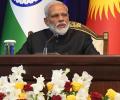
Modi hits out at trade protectionism and calls for a rule-based, transparent, anti-discriminatory, open and all inclusive WTO-centred multilateral trading system focused so that the interests of every country specially the developing ones can be taken care of.

Prime Minister Narendra Modi, in bilateral talks with Chinese President Xi Jinping, emphasized that both nations must show sensitivity to each other's core issues and be guided by mutual respect, sensitivity, and interest. Modi highlighted the critical importance of peace and tranquillity along the Line of Actual Control for the development of India-China relations, while also addressing concerns regarding Taiwan and Tibet.

An independent study reveals that while Geographical Indication (GI) registration has boosted the identity of Kerala's traditional handloom products, it has not uniformly translated into economic benefits across weaving clusters. Challenges include an ageing artisan population, competition from powerloom products, rising raw material costs, and inadequate marketing.

In recent years, China and Russia have pushed for de-dollarisation within BRICS, which India has resisted. One reason is that India does not want to hurt its relationship with the United States, and another is the fear of China controlling trade because the renminbi is considered the strongest currency in the bloc today.
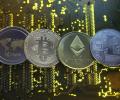
Indian crypto exchanges and companies have expressed strong support for the Central Board of Direct Taxes' (CBDT) new Crypto Asset Reporting Framework (CARF), which mandates reporting and due-diligence obligations for crypto service providers on all transactions starting 2026.

Dhaka and Beijing on Thursday agreed to strengthen cooperation on the management of the Teesta and other rivers and signed 13 agreements to bolster bilateral ties following talks between Bangladeshi Prime Minister Tarique Rahman and Chinese Premier Li Qiang.

The BRICS grouping adopted a consensus joint declaration in New Delhi, successfully navigating differences on the West Asia conflict but notably omitting any direct mention of US strikes on Iran or Iranian military attacks on Gulf Arab nations. The declaration also criticised Israel's actions in Gaza and called for a concerted approach against terrorism.

National Security Advisor Ajit Doval engaged in Special Representatives talks with Chinese Foreign Minister Wang Yi in Beijing, focusing on the India-China boundary question and enhancing bilateral relations. These crucial discussions precede Chinese President Xi Jinping's anticipated visit to New Delhi for the BRICS summit, aiming to address persistent border differences and stabilise ties strained by past conflicts like the Galwan Valley clash.

Notwithstanding the economic complementarities and the host of agreements for deepening economic relation on a host of areas, both sides share common viewpoints on the foreign policy domain and seek common grounds to serve as a counterweight to China, notes Dr Rajaram Panda.

Underlining that students are the "architects of India's future," President Droupadi Murmu on Friday said the government is taking comprehensive steps to reform public examinations to completely curb paper leaks and unfair means, making the system transparent, secure, and trustworthy.

As many as 274 fugitives have been repatriated from 36 countries in the last 7 years, an average of around 40 per year and a 10-fold jump from the 2004-13 period when around four fugitives were brought back every year, the government said on Tuesday.

The visit was expected to project Assam as the gateway to Southeast Asia and reinforce the state's emergence as a preferred investment destination.

For India, the guiding principle should remain clear: Engage Bangladesh as a sovereign nation and society rather than through the prism of any individual leader or political party, suggests Manoj Mohanka.

President Donald Trump has withdrawn the United States from over 60 international organisations, including United Nations bodies and the India-France-led International Solar Alliance, calling the institutions 'redundant' and 'contrary' to America's interests.

'After announcing that she will return to Bangladesh, if she does not, her credibility will suffer.'

The OECD projects India's GDP to grow at 7.6% in the current fiscal year and 6.1% in 2026-27, despite global economic challenges stemming from the Middle East conflict and energy price volatility.

A new report suggests that prolonged conflict in the Middle East could significantly impact India's GDP growth and inflation.
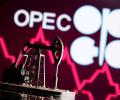
The United Arab Emirates has announced its decision to withdraw from OPEC and the wider OPEC+ alliance, effective May 1, 2026, signalling a significant policy-driven evolution in its long-term energy strategy aimed at aligning with domestic economic goals and increased production investment.
The United Arab Emirates has announced its decision to withdraw from OPEC and the wider OPEC+ alliance, effective May 1, 2026, signalling a significant policy-driven evolution in its long-term energy strategy aimed at aligning with domestic economic goals and increased production investment.
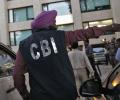
The CBI has filed three chargesheets against former Karnataka minister B Nagendra and his associate Nekkanti Nagaraj for allegedly diverting Rs 89 crore in state government funds intended for Scheduled Tribes.

India has strongly condemned Pakistan's military airstrikes against Afghanistan, citing significant civilian casualties, and criticised its 'trade and transit terrorism' against Afghan traders, calling these actions blatant violations of international law and UN norms.

Nand Kishore Yadav has been sworn in as the new Governor of Nagaland, succeeding Ajay Kumar Bhalla. He pledged to uphold the Constitution, promote development, and preserve the state's cultural heritage.

The 2026 FIFA World Cup, co-hosted by the United States, Mexico, and Canada, is set to be football's largest tournament but will unfold against a backdrop of significant geopolitical tensions, including conflicts, strained alliances, and complex immigration policies, challenging its traditional role as a symbol of global unity.
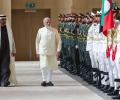
Prime Minister Narendra Modi has offered India's support to bring peace to West Asia during talks with UAE President Sheikh Mohamed bin Zayed Al Nahyan. Both countries signed agreements to strengthen strategic collaborations in energy and defence.
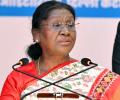
President Droupadi Murmu addressed a national convention, acknowledging the progress of women in various fields while highlighting the persistent social stereotypes, economic inequalities, and psychological barriers they face. She called for collective efforts to address these issues and emphasised the importance of promoting Indian languages and traditional knowledge systems.
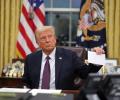
US President Donald Trump signed the National Defence Authorisation Act for Fiscal Year 2026 into law, highlighting broadened engagement with India and addressing the challenge posed by China in the Indo-Pacific region.

Following an examination and discussions held in the aftermath of the United States' decision to withdraw from dozens of international organisations, Israel's Minister of Foreign Affairs, Gideon Sa'ar, has decided that Jerusalem will immediately sever all contact with several United Nations agencies and international bodies, citing what the government described as persistent bias, politicisation and actions hostile to Israel.
